What Is a Graded Pokémon Card?
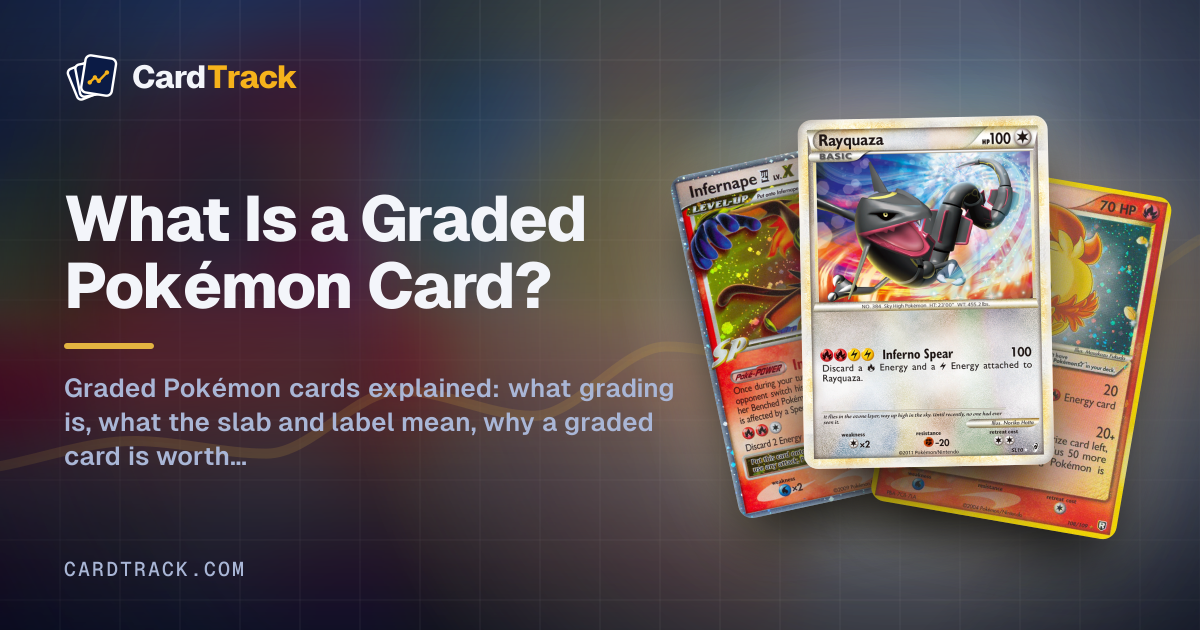
If you ever see a Pokémon card encased in hard plastic with a label on top, it's not just for looks. It's a graded Pokémon card — what collectors call a 'slab' — which means it has been authenticated and given a condition grade. And a high grade usually makes it worth more than a raw copy.
What Grading Is
Grading in card collecting means you take a card you pulled (or bought from a friend) and pay someone — not the Pokémon Company, not your friend, and not the shop you bought it from — to authenticate it and 'grade' its condition.
So who do you pay to have your raw Pokémon card graded and encased in hard plastic? They're called 'graders', and no, they aren't someone you meet in a dark alley. Graders are companies whose whole business is grading cards. You've most likely heard of them by name: PSA, CGC, Beckett Grading Services (BGS) and TAG, to name a few.
Each grader has its own grading system. PSA — the best known, for its name recognition, its fees and the value a PSA grade adds to a card — uses a 1-10 scale. BGS is known for its subgrades. They do have something in common, though: every grader evaluates and scores the same four things.
- Centering: how centred the artwork is relative to the borders — top and bottom as well as the sides.
- Edges: are they free from chips, and is there no 'whitening' from handling?
- Surface: stains, scratches and scuffs all affect the final grade.
- Corners: each corner should be free from visible damage.
After evaluating these four, the card is given its final grade, sealed in hard plastic and labelled (more on those two below).
Tip: if you're thinking of having your cards graded, our guide on how to get a Pokémon card graded walks through the whole process.
The Slab & Label
What makes a graded Pokémon card different from a raw single is the plastic case and the label.
Let's start with the clear plastic case, or slab. Graders seal the card inside it for two reasons: to lock in the card's condition, and to protect it from dings, scratches and anything else that could devalue it.
The slab itself varies by grader. CGC's holder is thicker, with crystal-clear plastic; PSA's is slimmer. Once you've handled a few, you can usually tell who graded a card from across the room.
Now, the label. Every graded card has one. Without it, a card is just sealed in a plastic case — nothing more, nothing less. Think of the label as a certificate.
It sits inside the slab, just above the top of the card. It carries the card's details (name, number and set), the grader's logo, a certification number and, of course, the grade. Labels also have a barcode or QR code that you can scan to verify the certification on the grader's website. Designs differ too: PSA's label has its familiar red border, while CGC saves its gold label for a Pristine 10.
Fun fact: you might think a label would be easy to copy, but grading companies build anti-counterfeiting features into their labels and holders, such as holograms and inks that are hard to reproduce.
Why Worth More
Compare a raw card in Near Mint condition with its PSA 10 counterpart. They might look the same, but one thing is different: the price. Why? Because anyone can claim a raw card is flawless, while a graded card has been checked, verified and authenticated — and a certification backs it up.
Think of it like buying a used car. Buy directly from the owner and they might swear there's nothing wrong with it, but there's no paperwork to prove it. Buy from a dealer and you'll pay more, but you get the inspection certificate.
The gap can be big. Right now a raw Umbreon VMAX 215 from Evolving Skies sells for around $1,870, while a PSA 10 copy goes for about $3,800 — roughly 2× the raw price for the same card in a slab.
Should You Grade?
Now that you know what a graded Pokémon card is, the next question is whether you should grade your own collection. The honest answer: it depends on what you have, its condition and whether there's demand. Work through this checklist:
- First, check the price gap between a raw and a graded copy with our Pokémon Card Value Checker. The bigger the gap, the better.
- Check how often your card actually gets the top grade in the PSA Population Report. As a rough guide, a gem rate under 5% means PSA 10s are scarce, while over 60% means most submissions come back a 10. The Umbreon VMAX above has a gem rate of about 70%, so a 10 is the expected outcome for a clean copy; the Umbreon ex 161 from Prismatic Evolutions sits at about 30%, which is a big part of why its PSA 10 ($4,700) is worth around 4.3× its raw price ($1,100).
- Check your card's condition and centering before you send it. Our AI card grader gives you a predicted grade from a photo, and the centering calculator measures the borders. Remember, graders look at surface, centering, corners and edges.
Grading costs money and can take a long time, so make sure the card is worth it first. If you want the shortcut, our best cards to grade list ranks the cards where the graded premium comfortably covers the fee, and this guide goes deeper on the maths.
FAQ
Can You Use Graded Pokémon Cards in Tournaments?
No. If you're competing, you can only play raw cards — a slab doesn't fit in a sleeve or a deck. Cards also have to be in a language that's legal for your region; in most regions that means the local language or English.
Is a Graded Slab Permanently Sealed?
A graded slab is tamper-evident. Grading companies use ultrasonic welding to fuse the two halves of the holder together — no glue, no screws. Opening one means breaking it, which voids the grade. Keep in mind that this doesn't make the slab waterproof.
Can Graded Slabs Be Faked?
Unfortunately, yes. Signs of a fake graded Pokémon card include air bubbles, rough seams and corners, and injection marks in the plastic. When in doubt, look up the certification number or scan the QR code — and make sure you're on the grader's official website when you do. Our guide to spotting a fake Pokémon card covers the card inside the slab too.
Data and sources behind this article
CardTrack data pages: Blog The Psa Grading Scale Explained 1 10 · Blog How To Get A Pokemon Card Graded · Card Evolving Skies Umbreon Vmax 215 · Set Evolving Skies · Pokemon Card Value Checker · PSA population report · Pokemon Card Prismatic Evolutions Umbreon Ex 161 · Pokemon Set Prismatic Evolutions · Pokemon Card Grader · Pokemon Card Centering · Blog How Much Does It Cost To Grade A Pokemon Card · Best cards to grade · Blog Is It Worth Grading Pokemon Cards · Blog How To Tell If A Pokemon Card Is Fake
Latest Pokémon market report · live
November 2026 — Vintage Pokémon cards outpaced modern chase by 10.3 points over the past 30 days. 1 November 2026
Go to the numbers: Grading cost guide · Grading ROI calculator
Comments
No comments yet — be the first to weigh in.