The Pokémon card market, measured.
Indices, record sales, scarcity and grading data built from CardTrack's own pricing and sales ledger — permanent URLs, dated figures, downloadable charts and tables, and a stated method behind every number. Free to cite under CC-BY 4.0: credit “CardTrack” and link the page.
Indices
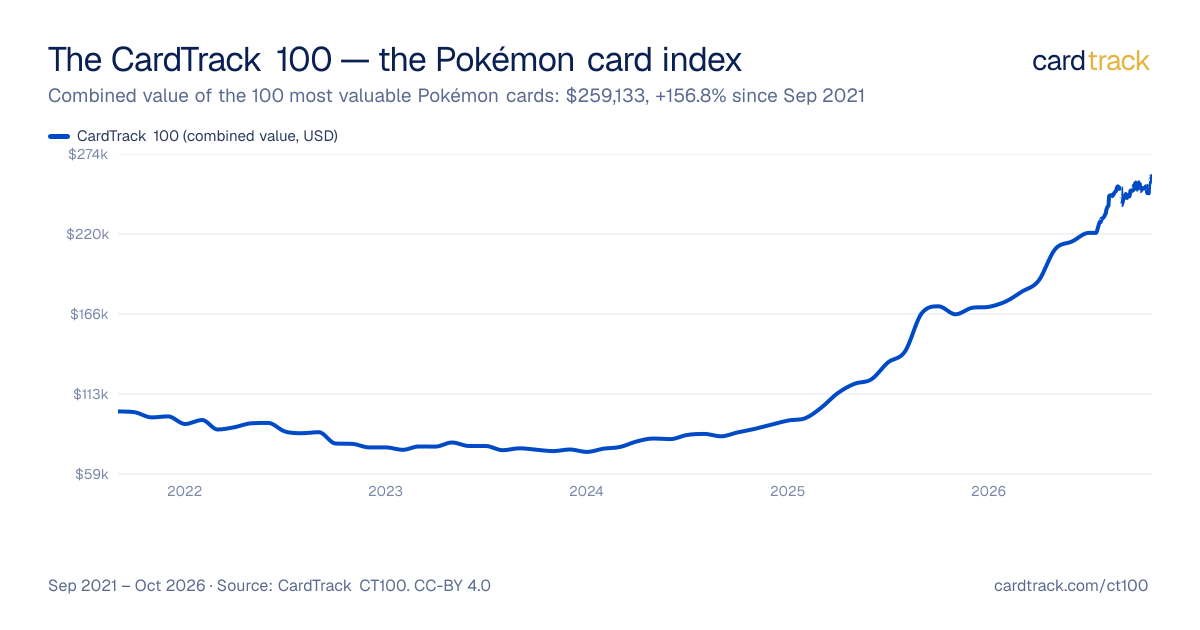
The CardTrack 100
The 100 most valuable Pokémon cards as one value-weighted index, rebalanced monthly. Level 257, +156.8% since Sep 2021.
The Pokémon card market cap
Every PSA, CGC and BGS graded Pokémon card at its grade's price: 30.7M priced slabs of 42.5M, per card and per Pokémon.
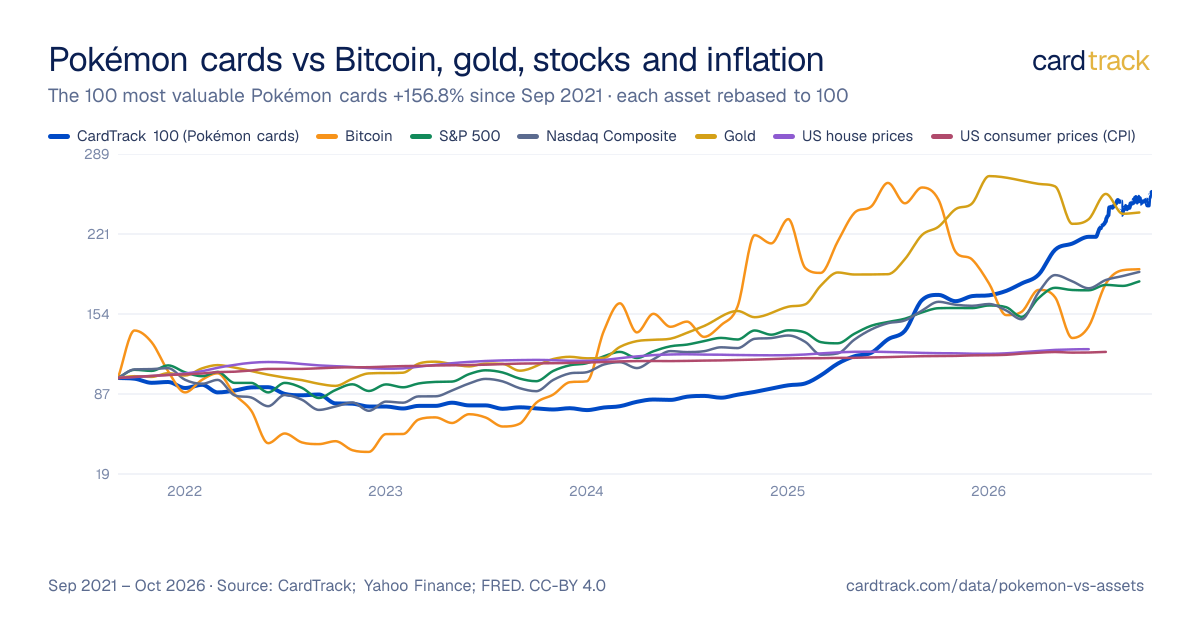
Pokémon cards vs Bitcoin, gold, stocks & inflation
The CT100 ranks 1 of 7 assets since Sep 2021 on total return, with drawdown and volatility over 1, 3 and 5 years.
Seasonality: what each month has done to card prices
The median card's return in every month since Jan 2021, year by year and by era. December is the strongest month on the median card (5 of 5 years up), May the weakest (-0.1%).
The PSA 10 premium index
What a PSA 10 fetches over the same card raw, as a market-wide median across 2,434 cards; 9.4× a year earlier.
Market data
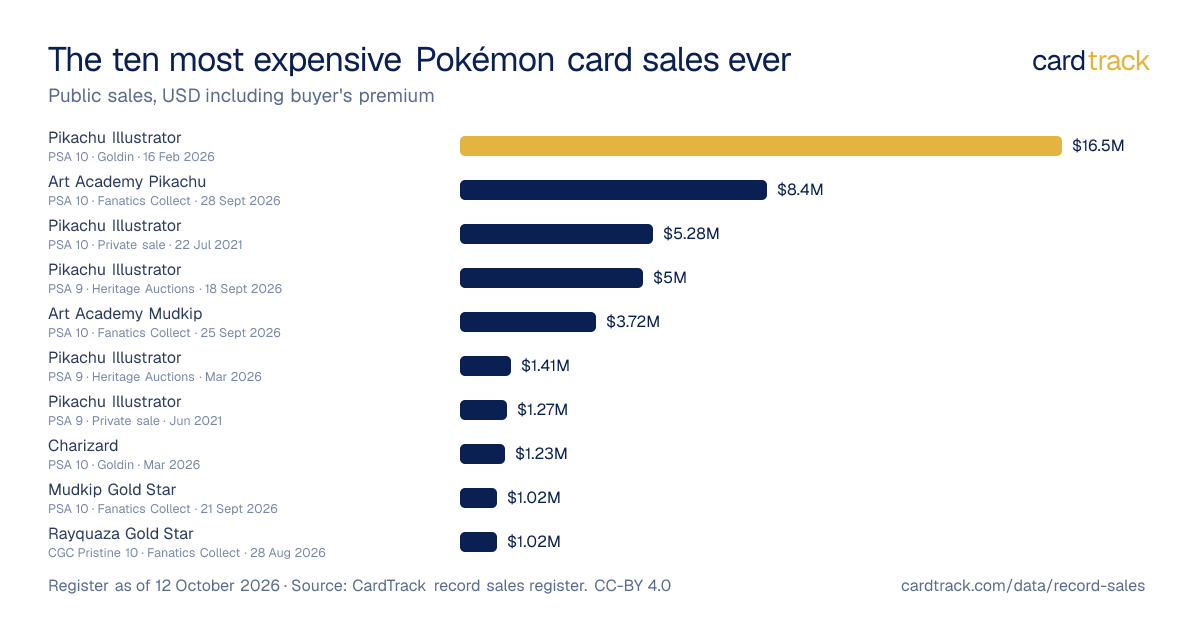
Record sales: the most expensive Pokémon cards ever sold
33 verified public sales of $100,000+, with sources. 10 at $1 million or more; record Pikachu Illustrator PSA 10, 16 Feb 2026.
The grading guide: every grade as a share of PSA 10
What a PSA 9, a PSA 8, a raw copy, a CGC 10 or a BGS 9.5 fetches against the same card's PSA 10, on real sales, across 6,418 cards; and how often each grader gives its gem, by era.
PSA population report
16,264,260 graded copies across 19,676 cards; 5,881,546 PSA 10s. Rarest gems, hardest cards to grade, population by era and set.
The top 100 by what was paid
The most expensive cards ranked on the median of their own completed graded sales over 24 months, with relists and re-reported sales collapsed; 27 cards carry a $100,000+ median and the hundredth place costs $38,250.
Most valuable Pokémon cards today
The current market value ladder — what the top cards are worth now, raw and graded — distinct from the record-sales register of what was paid.
Most traded Pokémon cards
Which cards actually change hands: sold-listing counts and turnover from the sales ledger.
Price movers
The biggest 30-day risers and fallers across the catalogue, with the sales behind each move.
Hype index
Search and social attention by card and set, read against price.
Market overview
Cross-market spreads and the state of the Pokémon card market in one view.
Pokémon card data studies: PSA 10 rates, liquidity, prices and concentration
PSA 10 gem rate by set: every English Pokémon set ranked
Share of PSA-graded English cards that are PSA 10s, for every set, era and release year, with the hardest cards to gem.
Pokémon card liquidity: how often each card trades
How many times each English card traded in 30 days: the median card, the cards with no sale, and how much of the volume a few cards carry.
Offer discounts on graded Pokémon cards: where buy-now listings clear against the ask
What graded buy-now listings actually clear at: how often the ask is paid, and how far below it accepted offers go, by price band.
Pokémon card dollar volume: how concentrated the money is
How the money spent on Pokémon cards spreads over sales, cards, grades, sets and venues: the share in the top 1%, and what the long tail adds up to.
Sales volume by Pokémon: every character ranked by trades and dollars
Every Pokémon ranked by the sales and dollars of cards that show it, with the generation split and English against Japanese.
Auction house vs eBay: the price spread on the same graded Pokémon card
The same graded card sold at an auction house and on eBay: the median price ratio, by house, band, grader and eBay format.
Cost to complete every English Pokémon set, at near-mint prices
One near-mint copy of every card in each English set: the cost, per card, top-card share and PSA 10 cost, by set and era.
Japanese vs English PSA 10 prices: the same artwork, compared
The same artwork in Japanese and English PSA 10: the median price ratio, by band, era and set, for every compared pair.
Reports
Pokémon card market reports
Dated monthly, quarterly and annual editions with the index, movers, grading and liquidity for the period — each with a JSON download and an embed.
Market report
The current state of the market: breadth, trend, sets rising and falling, and the cards driving it.
Methodology
How CardTrack prices cards, builds its indices and reads graded and raw sales.
Media resources
Every asset above carries a “For media” panel with its updated date, source, suggested attribution and downloads. The files are collected here; the live CT100 embed is free to use with a source line.
For media
Free to cite · CC-BY 4.0- Updated
- RefreshesDaily; the record register weekly
- SourceCardTrack's pricing pipeline and sales ledger (eBay, Fanatics Collect, Goldin, Heritage, PWCC, PriceCharting history), PSA and CGC population reports, Yahoo Finance and FRED for benchmarks.
Source: CardTrack (cardtrack.com), 24 October 2026.- CSVCT100 history
- CSVCT100 constituents
- PNGCT100 chart
- CSVPokémon vs assets history
- PNGPokémon vs assets chart
- CSVRecord sales register
- PNGRecord sales chart
- CSVPSA population report
- CSVMarket cap history
- CSVMarket cap by Pokémon
- CSVSeasonality by month and year
- CSVGrading guide: grades as a share of PSA 10
- CSVTop 100 by what was paid
- CSVPSA 10 premium history
- CSVPSA 10 gem rate by set (study)
- CSVPokémon card liquidity (study)
- CSVOffer discounts on graded cards (study)
- CSVDollar-volume concentration (study)
- CSVSales volume by Pokémon (study)
- CSVAuction house vs eBay (study)
- CSVCost to complete every set (study)
- CSVJapanese vs English PSA 10 (study)
- DOCMethodology
Charts and tables may be reproduced with the attribution above under CC-BY 4.0. How the numbers are built: methodology. Press enquiries, corrections and custom cuts of the data: jd@cardtrack.com. CardTrack is a market measure, not investment advice.
Journalists and researchers: for a figure that is not on these pages — a custom date range, a set, a character, a grade — e-mail jd@cardtrack.com and say how you plan to use it. Turnaround is usually same day.